As BETT 2026 concludes London, it is a rare but perfect moment to reflect on my two greatest passions: construction project data and education technology.
As the Marketing Director at Barbour ABI, I spend a lot of my time looking at data, pipelines, and the shifting tides of the construction industry and built environment.
I have always been a firm believer that a great education is the single biggest enabler for social mobility. However, as we have seen time and again, that ladder needs a solid foundation. You cannot deliver a world-class, 21st century education in a 20th century building. That is why the intersection of these two worlds and how we build the physical spaces that house our digital future is so critical.
BETT 2026 signals a new mandate for education construction infrastructure
Directly from the halls of the ExCeL London and BETT 2026, the mandate for the construction supply chain has never been clearer. While previous years focused on the tools of learning, this year’s opening speeches shifted the focus somewhat to the infrastructure that enables them.
The opening address by Bridget Phillipson, the Secretary of State for Education was a direct call to the construction sector. The keynote highlighted an infrastructure gap, the reality that world-leading EdTech cannot function in buildings that act as a throttle on connectivity.
Three core requirements shaping modern education construction
For the supply chain, the BETT mandate translates into three specific requirements:
Decoupling Shell from Tech:
Opening speeches emphasised that while building cycles are 30 years, tech cycles are three. Projects like Framwellgate are utilising accessible infrastructure channels, allowing MEP contractors to upgrade fibre and power arrays without disturbing the primary building fabric.
The Building as a Teacher:
Following the BETT focus on ‘Environmental Pedagogy’ (education focused on environmental responsibility and action, fostering a sustainable future), these new builds are moving services into the spotlight. HVAC systems and renewables are no longer hidden but are integrated with real-time energy dashboards that students use as part of their curriculum.
Adaptive Platforms:
Reflecting Ele George’s Churchill Fellowship research, the DfE is pushing for Platform-based Manufactured Systems. This means the supply chain must provide modular, high-precision components that allow school layouts to be reconfigured as teaching styles evolve.
Major UK education construction projects driving 2026 pipeline
The scale of this mission is evidenced by the recent batch of main work contracts signed by the DfE. Three major secondary school projects, totalling over £130 million in combined value, are leading the charge into the 2026 delivery phase:
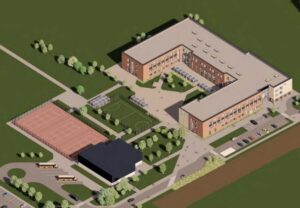
Framwellgate School, Durham (£68m): Awarded to BAM, this flagship project is the gold standard for adaptive infrastructure. It fulfils the BETT vision by utilising active thermal mass cooling to balance the high energy demands of AI server hubs with its Net Zero Carbon in Operation (NZCiO) targets.
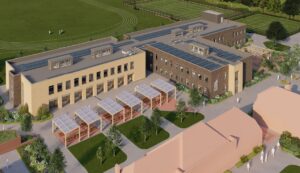
Sawston Village College, Cambridgeshire (£32m): Delivered by Bowmer & Kirkland, this redevelopment focuses on the human-centred aspect of Ele George’s research ensuring that the high-efficiency factory-built elements provide a learning environment that prioritises student wellbeing and air quality.
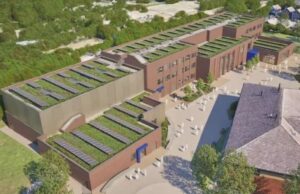
Friesland School, Sandiacre, Derbyshire (£31m): Also secured by BAM, this project emphasises the replacement of outdated blocks with specialised teaching spaces designed for the high-bandwidth requirements of 2026 pedagogy.
This 2026 surge in smart construction addresses a striking disparity identified in recent Churchill Fellowship research. While nations like Sweden and Germany deliver nearly half their new homes and public buildings through custom-build models that harmonise factory efficiency with genuine choice, the UK has traditionally achieved less than 1 in 10.
Why platform-based manufacturing is critical to education construction at scale
The mission for 2026 is practical transformation. By adopting platform-based manufactured systems, the UK construction supply chain can move away from ‘mere mortal’ builds toward scalable, high-precision models. This shift allows us to rethink what’s possible for policymakers, builders, and residents alike. In the face of a national infrastructure tipping point, we urgently need these models to be both scalable and human centred.
What BETT 2026 means for manufacturers and subcontractors
For manufacturers and subcontractors, the BETT 2026 opening ceremony changed the statement of requirements for every product in the school estate. The focus has shifted to passive intelligence. Products, from acoustic glazing to insulation must now be considered active parts of the data ecosystem.
Can your cladding support integrated 5G small cells? Does your flooring allow for the rapid reconfiguration of modular power points?
The supply chain must bridge the gap by providing:
IoT and Wellbeing Sensors: Integrated directly into the Building Management System (BMS).
Data-Backed Sustainability: Digital twins of every installation to provide verifiable energy-performance data.
Acoustic Flexibility: Advanced solutions for the hybrid realities where physical and remote learning merge.
Turning education project data into delivery-ready projects
Our data at Barbour ABI indicates that 2026 is a crucial year for school contract awards. We are seeing a 20% uptick in projects requiring smart building integration in their initial planning briefs.
Our mission is to ensure that the UK’s capital investment delivers more than just physical shells; we are facilitating the high-performance infrastructure required for digital pedagogy to function.
Barbour ABI provides the commercial precision needed to move beyond conference theory and turn international best practice into shovel-ready UK projects. We are moving away from simple square footage toward high-spec, future-proofed estates designed for long-term educational impact.