As the UK continues to face sustained pressure on housing supply, attention remains firmly on how homes are designed, manufactured and delivered. Offsite construction has been part of that conversation for more than a decade, but its role within UK housing is evolving. Rather than representing a single solution, offsite housing now reflects a spectrum of approaches shaped by market conditions, policy, skills availability and delivery risk.
Understanding how offsite fits within today’s housing landscape requires a more nuanced view than the simple distinction between “traditional” and “modern” construction.
Offsite housing in a challenging market environment
The UK housing sector has experienced significant volatility in recent years. Fluctuations in housing starts and completions, rising build costs, skills shortages and economic uncertainty have all influenced how homes are delivered. Within this context, offsite housing has demonstrated both resilience and vulnerability.
Panelised systems, particularly timber frame, are now an established part of residential delivery, especially in low-rise housing and affordable schemes. At the same time, parts of the volumetric modular sector have faced disruption, highlighting the sensitivity of capital-intensive manufacturing models to changes in demand and pipeline certainty. These contrasting experiences underline an important point: offsite housing does not operate independently of the wider housing market.
From systems to solutions: the rise of hybrid delivery
One of the most notable developments in recent years has been the growing use of hybrid construction models. Rather than replacing traditional methods, offsite systems are increasingly being combined with conventional onsite construction to manage programme, cost and risk.
This hybrid approach allows developers and contractors to apply offsite where it adds the most value – such as panelised envelopes, pods, or structural components – while retaining flexibility in design and sequencing. For many housing providers, this selective use of offsite has become a pragmatic response to skills shortages, site constraints and the need for delivery certainty.
Policy, procurement and confidence
Public-sector policy and procurement continue to influence offsite adoption, particularly in affordable housing. Frameworks, MMC requirements and quality assurance schemes have helped embed offsite within parts of the market, while also shaping how systems are specified and evaluated.
At the same time, regulatory change – especially around building safety, energy performance and product compliance – has increased the importance of assurance, traceability and long-term performance. For manufacturers and developers alike, confidence is now as critical as innovation.
Looking ahead
Offsite housing remains an important part of the UK’s residential construction toolkit, but its future is likely to be defined by flexibility rather than uniformity. Continued interest in panelised systems, selective recovery in volumetric approaches, growth in retrofit applications and ongoing investment in digital design and manufacturing all point towards a sector that is adapting rather than retreating.
The challenge – and opportunity – lies in aligning offsite methods with real-world housing delivery conditions, recognising that no single system or model fits every project.
“The UK offsite housing sector reflects both opportunity and constraint. Adoption has broadened across residential applications, but activity remains closely tied to housing market conditions, supply-chain capacity and the ability of manufacturers and developers to adapt delivery models. Recent volatility has reinforced the importance of flexibility, particularly the use of hybrid approaches that combine offsite systems with more traditional construction methods. As a result, offsite is increasingly being applied selectively, where it best supports programme, cost and delivery certainty rather than as a one-size-fits-all solution.”
– Anne Williams, Editor of the report.
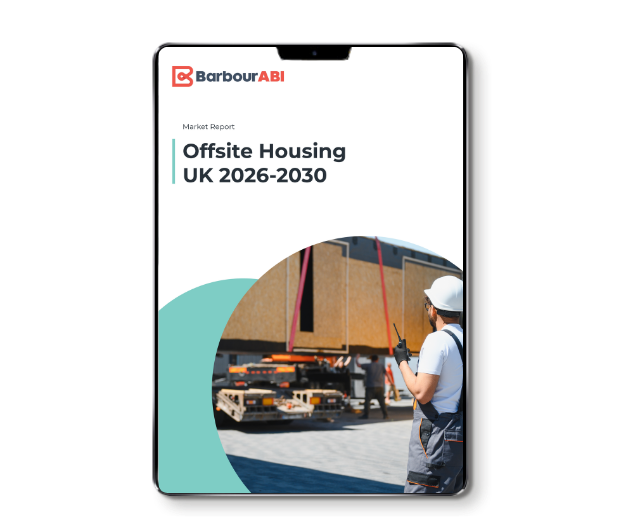
Offsite Housing Market Report by Barbour ABI
Our latest report provides an up‑to‑date assessment of the UK’s evolving offsite housing sector, including market sizing, growth prospects, and the key forces shaping adoption across the residential landscape.
Drawing on both primary and secondary research, the report examines how housebuilding activity, manufacturing capacity, skills shortages, digital construction, and regulatory pressures are influencing the trajectory of offsite delivery.
Click below to view this report on our store website where you can see an exhaustive list of the table of contents, commentary, and more.