The Assets & Channels
So, once we had the idea confirmed for this year, we got to work on building the assets.
In this section, we will break down each channel that we used and the assets that we built throughout.
With all our campaigns, we adamantly adhere to our Distinctive Brand Assets, ensuring that there is consistency across everything we do, to drive mental salience across our audience, so that when they are ready to buy, they recognise our brand.
The Assets
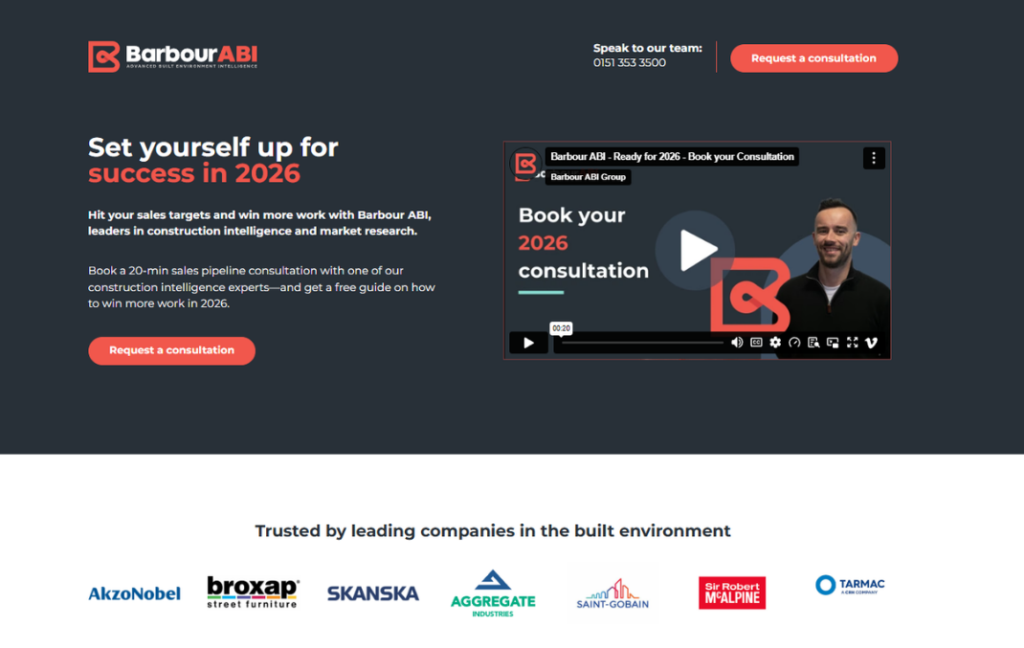
The landing page may well be the most important asset of any campaign. You can have the best emails, social posts, adverts and salespeople driving people to your landing pages, but if the place that everybody lands on isn’t set up to convert well, then it’s all for naught.
There are a few easy key points to hit on a landing page to make optimisation as easy as possible:
- Keep key information “above the fold”. Don’t make anybody scroll before they hit your CTA. If someone gets bored, overloaded with info or confused they won’t convert.
- Make sure wording and CTAs are consistent on the landing page with what they were in the place that the prospect was driven from. You don’t want to lose anybody because the offer suddenly seems different than what they clicked on.
- Have all assets on the landing page matching your Distinctive Brand Assets. Colours, logos, videos, audio cues and anything else must all be consistent. Prospects are hyper vigilant. If something doesn’t look like your brand then they could disappear due to thinking they’ve landed on a page that they don’t trust.
- Social proof – Put your leading clients names front and centre to build trust and respect from the prospects in the same fields that you’re hoping to win over.
Free Guide:
For lead gen campaigns, it can sometimes help to have free sweeteners to drive conversions. You may consider guides, playbooks, white papers or how-to documents that subtly (or not-so-subtly) introduce a problem to audience and showcase how your product offering solves the problem.
Free guides can be a double-edged sword though. As with many other types of marketing assets, there are more of these guides in the world delivering less value than ever before.
There is also the risk that people only want the guide and aren’t interested at all in the thing you want them to be. Maybe they’re not interested in your demo, they just want the guide. This will frustrate your sales team and possibly lead to distrust in the value of your marketing leads long-term.
Be honest and brutal with yourself when making these guides. Are you making them because they’ll improve the user’s experience, or because you just hope that it’ll drive a conversion?
Thankfully for this campaign, the guides worked well as a driver of conversions and a conversation starter for the sales team. But we’re constantly re-evaluating to see if this is still going to be the case for the next campaign that we run.
Exit Overlay:
An Exit Overlay is a massively undervalued asset for any marketing team, that if updated consistently and cleverly, can be a major boon to your campaigns.
You can have great incremental gains from a good exit overlay rollout. You never know which passing traffic will bite on them that otherwise would’ve left your site without ever handing over their details.
The key for success with these is to make sure they’re appearing on the right pages at the right time.
If you have a page specifically designed for marketers, make sure you’re not hitting them with something that’s only relevant for a HR department.
And make sure to keep on top of what exit overlays are active on your site. For instance, the article you’re reading was written in July 2026. We’d look pretty stupid if the exit overlay you saw on this page was still asking if you’re ready for 2026.
The Channels
Email:
Email is still a major channel for us, but as with many other brands, it’s taken more of a backseat in recent years.
Historically, short, snappy emails converted well for us. Nowadays, rich emails that give away lots of content are what drives enough interest in readers to persuade them to click through.
Email inboxes are so full now, that a short message typically won’t cut it, unless the recipient is firmly within that 5% sweet spot of those ready to buy immediately.
We now add multimedia to our emails: video, PDF downloads and blog links throughout the body drive more success typically than short emails (although these do still have their place to a bottom of funnel audience).
Throughout this campaign, we sent over 20,000 emails to our prospect list.
Social Media:
A mix of social posts: organic and paid ads from both the company account, as well as the same approach from personal accounts.
A lot of businesses, especially in construction, struggle to persuade team members to get involved in socials.
The data on this is very clear: posts from personal accounts will always outperform company posts on LinkedIn.
If you’ve got anyone at your company willing to get themselves in front of a camera or to write a few words on your latest campaign, make sure you milk that resource for all its worth!
Test what works best across your account and keep up to date with the latest recommendations for LinkedIn. At the time of this campaign, video was performing very strongly, hence why we posted several videos from members of the team.
Carousels, single image posts or even simply plain text posts can work incredibly well, so be sure to test all different formats available on the platform.
Paid ads:
We ran ads across Google, LinkedIn and Microsoft.
Again, the key to these was a multimedia approach to reach different members of our audience in the way that would best appeal to them.
Video, single image, display and plain text ads were used across the various platforms.
We ran a mix of broad reach audiences, as well as retargeting ads with strong bottom of funnel messaging for audiences already familiar with us.